
Free DADGAD guitar tabs (PDF) and audio recording
The South Wind (An Ghaoth Aneas) is a beautiful traditional Irish melody with a gentle, flowing character. Often played as a slow air or waltz, it is a wonderful example of how a simple melody can convey a remarkable sense of warmth, longing, and nostalgia.
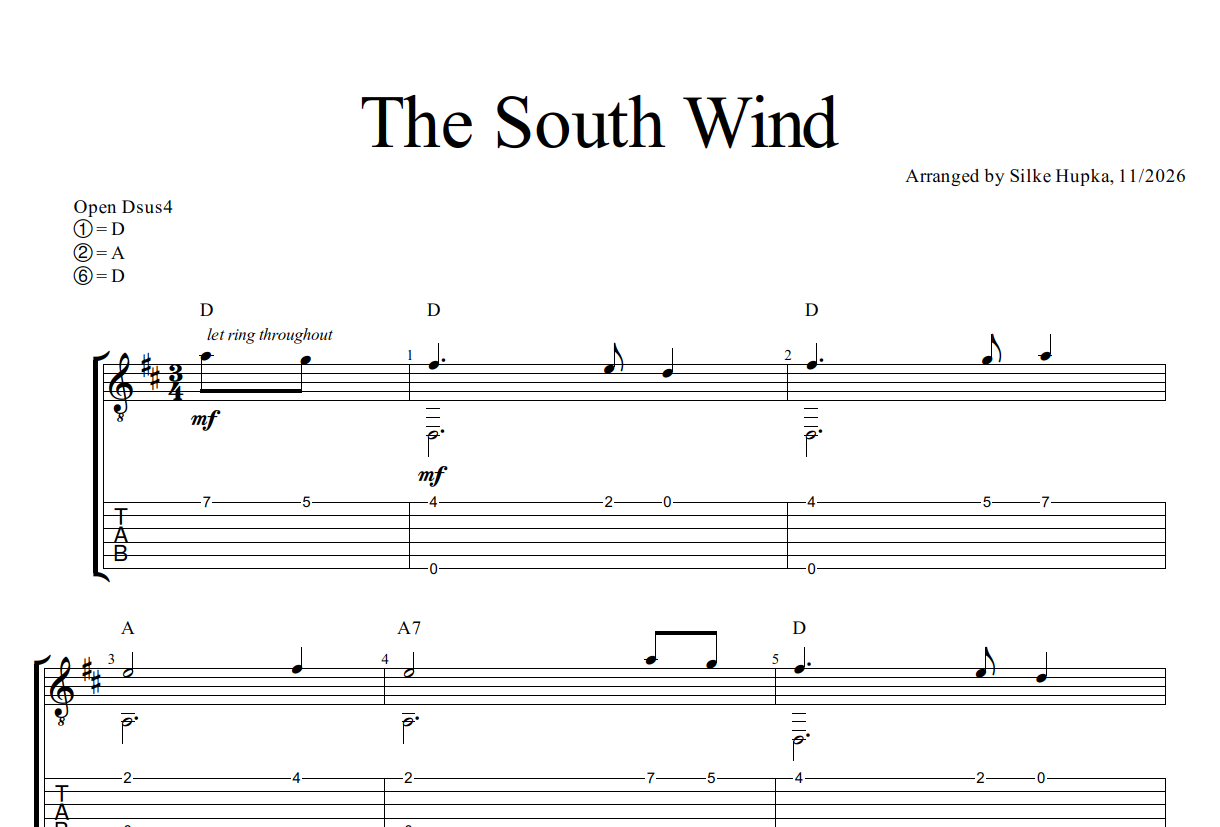
For this arrangement, I have transposed the tune to D major and added a minimal bass accompaniment, making full use of the open strings and natural resonance of DADGAD tuning.
The Story Behind The South Wind
The South Wind has its roots in the Irish musical tradition of the 18th century. The song is associated with Domhnall Meirgeach Mac Con Mara, also known as Freckled Donal Macnamara, a poet from County Mayo in the west of Ireland.
According to the traditional account, Macnamara was living in Munster, in the south of Ireland, far from his native Connacht. His longing for home inspired a song in which he addresses the south wind, asking it to carry his greetings northward to the people and places he misses.
The wind answers the poet, promising to carry his message to Mayo.
This poetic exchange gives the melody a meaning beyond its peaceful, pastoral character. The South Wind is also a song about homesickness, attachment to one’s homeland, and the hope of returning.
The melody has been preserved in Irish musical collections for more than two centuries. Edward Bunting included it in his A General Collection of the Ancient Music of Ireland, published in 1809, reportedly having collected the air in 1792.
Although the song is associated with Macnamara, the exact authorship of the melody cannot be established with certainty. Today, The South Wind is generally regarded as a traditional Irish air.
Arranging The South Wind for DADGAD Guitar
The South Wind is commonly played in G major. For my fingerstyle guitar arrangement, however, I have transposed the melody to D major.
This was primarily a practical and musical decision.
DADGAD tuning (D–A–D–G–A–D) provides three open D strings and two open A strings. In D major, these strings offer a particularly useful foundation for the melody and accompaniment.
Rather than creating an elaborate harmonization, I have chosen a minimal, moving bass line, played predominantly on open strings.
This approach has several advantages:
- Natural resonance: The open strings allow notes to ring freely, creating the spacious sound that makes DADGAD particularly attractive for traditional Irish music.
- A flowing bass accompaniment: Small movements in the bass provide harmonic direction without competing with the melody.
- Simple left-hand fingering: The limited accompaniment leaves the fretting hand free to concentrate on the melodic line.
- A clear musical texture: The melody remains in the foreground, supported by the characteristic open-string sound of DADGAD.
The result is a deliberately restrained arrangement. Instead of filling every available space with chords or additional voices, the guitar provides just enough harmonic support to let the melody speak for itself.
Listen to The South Wind
Here is an audio recording of my DADGAD arrangement. It provides an impression of the phrasing, tempo, and interaction between the melody and the open-string bass accompaniment.
Download the Free DADGAD Guitar Tabs
You can download my arrangement of The South Wind as a PDF containing the guitar tablature and standard musical notation.
Tune: The South Wind (An Ghaoth Aneas)
Origin: Traditional Irish
Tuning: DADGAD (D–A–D–G–A–D)
Key: D major
Time signature: 3/4
Arrangement: Fingerstyle guitar with minimal bass accompaniment

A Melody That Needs Very Little Accompaniment
What makes The South Wind particularly appealing to me is that the melody does not require an elaborate arrangement to be effective.
Its gentle movement and natural phrasing are already expressive enough.
DADGAD tuning offers an opportunity to support these qualities without overwhelming them. By combining the melody with a few carefully chosen bass notes, mostly played on open strings, the guitar can create a full and resonant sound with surprisingly little effort.
Sometimes, the most effective accompaniment is simply the one that leaves the melody enough room to breathe.
 I'm Silke, and I create the musical learning materials I once wished I had. I'm not Irish, but at least I'm a redhead! 😉

